'/%3E%3C/svg%3E%0A)
'/%3E%3C/clipPath%3E%3C/defs%3E%3Cg id='Group_626' data-name='Group 626' transform='translate(2 2)'%3E%3Cg id='Group_625' fill='none' stroke='%232cb34a' stroke-width='1' clip-path='url(%23clip-path)' data-name='Group 625'%3E%3Cpath id='Rectangle_509' d='M0 0h20.014v15.403H0z' data-name='Rectangle 509' transform='translate(.1 .1)'/%3E%3Cpath id='Path_663' d='m20.513.5-10.006 9.548L.5.5' data-name='Path 663' transform='translate(-.4 -.4)'/%3E%3C/g%3E%3C/g%3E%3C/svg%3E%0A)
'/%3E%3C/svg%3E%0A)
Effective risk management is among the most critical strategic assets available to local government. Without it, there’s no way to guarantee the stability our communities rely on.
Today, councils are challenged to balance their service provision with heightening economic volatility, extreme weather and emerging global risks. Embedding your risk management into a program that anticipates threats enables long-term institutional resilience.
Beyond protecting your own community, identifying an emerging risk or innovative solution can help strengthen the resilience of the entire CivicRisk Mutual network. Let’s talk about five risk management best practices for councils, and how CivicRisk Mutual is here to support you in actioning them.
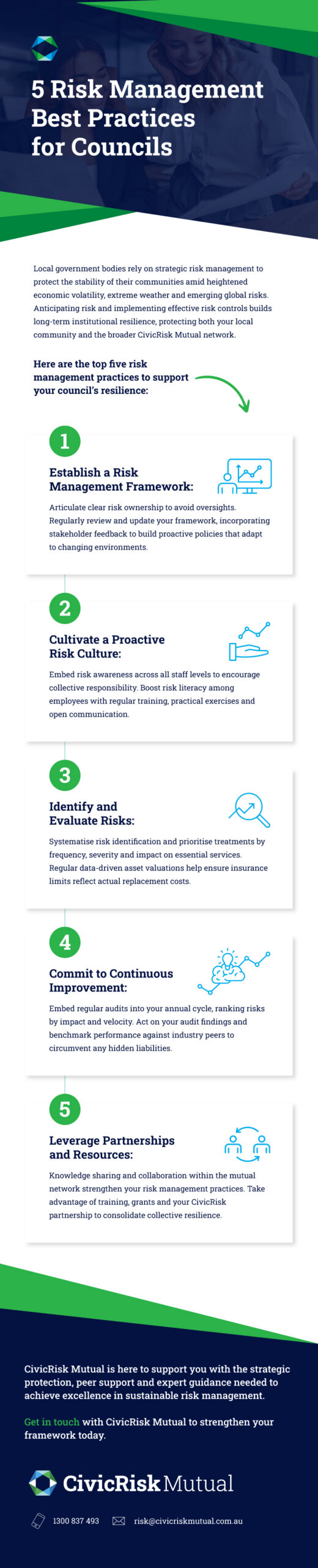
1. Build a Framework for the Real World
If our risk management frameworks are to respond to the real world effectively, they must be both robust and able to cope with the rapid onset of new and emerging risks.
Here are three ways to keep your risk management framework proactive and adaptable:
1. Define ownership: Clear ownership of risks provides less opportunity for them to fall between the cracks and not be well managed.
2. Keep the framework adaptable: Regularly review your framework to ensure its ability to respond to changes in the internal and external environments.
3. Regular integration: Regularly update risk assessments and consult stakeholders at all levels to identify new and emerging threats and opportunities.
2. Cultivate a Proactive Risk Culture
A positive risk culture means all staff can confidently identify and contribute to the management of risks. By embedding risk awareness throughout the organisation, councils encourage personal and collective responsibility, reducing the likelihood of a single point of failure.
Regular training and practical exercises provide hands-on experience to improve risk literacy across staff and leadership. Particularly in areas like cyber and climate risk, where the landscape is constantly changing, education keeps staff abreast with emerging best practices. Take advantage of our free virtual or in-person training to develop skills and competencies.
Transparent communication then reinforces this culture. When teams are looped in on emerging issues, management of risks becomes more robust and informs better planning decisions.
3. Systematise Risk Identification and Asset Valuations
Regular valuations ensure insurance limits reflect true replacement costs. CivicRisk Mutual provides scheduled property and content valuations; however, if circumstances change mid-cycle, you can request a one-off valuation.
Use data-driven insights to prioritise risk treatments based on frequency, severity and impact on essential community services. Ensure you identify and monitor the rare but catastrophic events specific to your community, too.
If you’re unsure, there are plenty of resources available to support you. Your council can get involved in the Annual Member Forum, the Risk and Claims Forums, the CRIP Support Group or talk to us about bespoke training.
4. Focus on Continuous Improvement Through Audits and Reviews
Make regular audits part of your annual cycle to validate internal controls. Every council has a unique risk profile, and the auditing cadence for each type and degree of risk will change. Here is a simplified framework to determine an effective auditing and risk review schedule:
- Rank risk by impact: User your risk matrix to identify extreme and high priority threats.
- Set an appropriate cadence: For instance, audit extreme risks quarterly and high risks biannually.
- Assess velocity: Review fast moving risks (like cyber) more frequently.
- Test your controls: Verify that your mitigation strategies hold under pressure.
Acting on audit findings helps avoid hidden liabilities. Dig into historic data to identify trends and modernise future risk mitigation strategies. Benchmarking your council’s performance against industry peers is also a valuable exercise in identifying gaps in operational protection.
5. Leverage Collective Strength and Shared Resources
Effective risk management should never fall on the shoulders of one council – or even one individual. By getting involved in CivicRisk Mutual’s collaborative community, we can help your council align with modern protection strategies – and ensure our services align with your council’s needs.
Every year, member councils can apply for the Risk Enhance grant to fund projects that solve core challenges for their communities — take advantage of them. The outcomes of these projects can create new standards that impact risk resilience far beyond your own council and community. One example is Mid-Western Regional Council’s Risk Management Framework 2.1, which was shared around councils, strengthening the resilience of our entire network.
Taking Control of Your Council’s Risk Resilience
Sophisticated risk management allows councils to lead rather than follow markets. Sustainable success requires a commitment to high standards and the power of mutuality.
Strategic collaboration with the CivicRisk Mutual network provides members with a necessary buffer against increasingly unpredictable global cycles. It also allows councils to tap into peer support and learning opportunities that raise our collective resilience.
For assistance in developing your risk management framework, get in touch with CivicRisk Mutual.